7 How and With What Purpose Have Objects Been Used in Conceptual Dance andor Live Art?
Introduction
Brainchild is a fundamental process in arts, such as in music and in the fine arts. In the latter (primarily in painting), this procedure is largely understood. In that location is a general consensus that abstract visual art presents non-figurative elements to the observer's visual system. These elements serve as vehicles for the artists to limited their ideas, for instance on the relationships and tensions betwixt these abstruse elements. Exposing the viewer to a visual scene without identifiable objects, the visual attention and range of associations that are evoked in the spectator's mind are likely to be unlike from those elicited when looking at recognizable objects (Augustin et al., 2008; Aviv, 2014; Chatterjee and Vartanian, 2014; Schepman et al., 2015).
However, dissimilar the fine arts (and music) the notion of abstraction is non obvious when considering trip the light fantastic. Indeed, trip the light fantastic toe is mediated by the human body (the dancer), which is a highly familiar object. Humans are experts in analyzing the movements of the human trunk, predicting its future trajectory and understanding the functional aspects of an action and its emotional content. Hence, is it at all possible to attribute the notion of "abstraction" to trip the light fantastic that is mediated by such a familiar and physical object – the human being body?
The term brainchild was actually referred to trip the light fantastic toe by diverse contemporary too as past choreographers and trip the light fantastic toe researchers, typically illuminating the intention of the choreographer to create trip the light fantastic toe without a narrative [eastward.g., Oskar Schlemmer'southward work in Lahusen (1986); William Forsythe's work in Nugent (2007)]. However, the present article focuses on the viewer'south experience rather than on choreographer's intention. It asks to what extent could the viewer perceive dance as being "abstract" albeit the dominant presence the dancer?
This article argues that it is indeed possible and useful to consider the process of abstraction in dance. It starts past presenting several definitions of the full general process of brainchild in both the fine arts and in science. Side by side, based on behavioral and neurobiological studies, it examines man motion in terms of perception, prediction, and empathy. Finally, the commodity shows why some features are candidates for abstraction in dance while other features are not fit for abstraction. Clarifying the process of abstraction in trip the light fantastic toe provides tools for dance analysis and is therefore useful for researchers, likewise as choreographers and dancers in their creative process.
On Abstraction
Abstraction is a way of acquiring knowledge about the world (Zeki, 2000).
It is mostly causeless that abstraction is a born process typical to people'south way of thinking (see Root-Bernstein, 2001; Zimmer, 2003; Grey and Alpine, 2007; Henriksen et al., 2014). The processes of categorization and classification such as grouping a dancer, a child, and a man sitting in a chair under the category of "human" inevitably involve abstraction, because they seek to preserve certain features shared by these objects while ignoring other features of these individuals. From this point of view, all fine art, including figurative painting, implements some degree of abstraction because it is never an accurate representation of reality per se (Gortais, 2003; Zimmer, 2003). Gray and Tall (2007) suggested that the abstraction process is governed by the pinch of knowledge into thinkable concepts, which yields a more sophisticated way of apprehending these concepts. In other words, brainchild is the process of building thinkable concepts from a state of affairs which tin can readily be accessed by more elaborate means of thinking and understanding. Several authors have argued that abstraction is a multilayered process, based on the power to focus on key features too as to find analogies between seemingly dissimilar entities (Figure 1A and Henriksen et al., 2014).
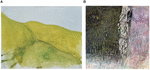
Effigy 1. Levels of abstraction in the visual arts. (A) An example of figurative or semi-figurative painting illustrating some of the characteristics of abstraction in art, such every bit selection (of gross forms simply, and using a express palette of colors), emptying (of pictorial details), amplification (of the forms such as silhouettes and the contours between them), and the analogy between dissimilar entities (the female body and a landscape); in Ori Reisman, Woman-landscape, 1960s, Oil on canvas, 130 cm × 97 cm, courtesy of the Reisman collection, Kibbutz Cabri, State of israel. (B) Fully abstract painting, eliminating any effigy or object representation, focusing only on the medium every bit means of expressions of ideas. Zvi Mairovich, Already More Most Than Far, 1966/68, Panda, 100 cm × 100 cm, Courtesy of Due south. Mairovich.
There is a general consensus that the procedure of brainchild, in particular in science and in art, involves selection and elimination. During abstraction, some elements of the target of abstraction are chosen to remain (choice), and tin can as well exist amplified, whereas other components are partially or totally eliminated (Figure one and Zeki, 2000; Root-Bernstein, 2001; Zimmer, 2003; Levins, 2006; Gray and Tall, 2007; Henriksen et al., 2014).
Because brainchild e'er involves choices of what is selected and how much is eliminated, it is clear that at that place is more than ane way to abstract the target of abstraction. This holds in both science and in art (Zimmer, 2003; Levins, 2006). The strength or meaningfulness of the abstraction can be assessed by the extent by which it preserves and emphasizes the key components of reality (in scientific discipline) or the visual reference in the globe (in the visual arts), leading to new insights and understanding of the subject matter (Levins, 2006; Henriksen et al., 2014). The strength of an abstraction is a subjective mensurate because its assessment depends on the community (e.g., scientists or artists), their interests, context and perspective. In science, researchers have argued that a productive brainchild should somewhen lead to a theory and not just to a description of a phenomenon every bit such (Levins, 2006). Beneath I use the concepts of selection, amplification and emptying to examine abstraction in dance. A comprehensive word of the notion of "abstraction" from philosophical, cultural, psychological, artistic and scientific, perspectives could exist found in Langer (1953) and Toscano (2008).
Abstraction in the Visual Arts
Observing abstruse visual art reveals some of its specific characteristics. One of these features is that abstract visual art exposes the viewer's visual system to an unusual state of affairs, in which the visual scene is made up of unrecognizable objects that escape categorization (Figures 1B, 2C) and therefore is likely to evoke dissimilar ("object-free") associations every bit compared to that invoked past a figurative painting such as in Effigy 2A (Kawabata and Zeki, 2004; Vartanian and Goel, 2004; Aviv, 2014). Another important feature of abstract visual art is that the basic means of expression (such as the brush traces on the canvass or the thickness of the paint) can become the chief message, as opposed to compositions of objects (the "content") in figurative fine art (Gortais, 2003; Zimmer, 2003; Belke et al., 2006). An interesting behavioral outcome of abstract visual art is the way that the visual scene is scanned past the observer. Whereas in figurative art the observer's gaze is focused mostly on salient recognizable elements in the scene (Figures 2A,B), in abstract art the viewer'south gaze wanders more uniformly over the whole pictorial scene, which is related to the level of abstraction (Pihko et al., 2011; Taylor et al., 2011, come across Figure 2C). Figures 2A,B demonstrate that when a human effigy is nowadays visually, the eyes are automatically fixated on the salient, highly recognizable, features of the person. This is the case in both the fine arts and the dance.

Effigy 2. Differences in middle scanning patterns of a figurative versus abstract painting. (A) Figurative painting, "Piipunsytyttäjät/Lighting pipes" by Rissanen (1902). (B). Eye tracking distribution of 20 individuals on this painting. Note the focal distribution of the fixation points that concentrates primarily on the faces, the pipe and the creative person's signature (replicated from Hari and Kujala, 2009). (C) Fixation (red lines) distribution on an abstract painting by Jackson Pollock. Note the wide trajectories of the eye tracking movements in the case of abstract art (replicated from Taylor et al., 2011).
Interestingly, eye-tracker studies on art perception have demonstrated that, admitting variability between viewers, there are common patterns of fixation on an art piece of work. Such patterns include fixating more on abrupt versus none-abrupt resolution and longer fixations on man and animals versus other not-homo figurative elements such equally clouds. These studies reveal that fifty-fifty in two dimensional representational paintings of human figures, the gaze of the viewer will examine more than the limbs of a "dynamic figure" (indicating a person in motion) rather than a "static figure" (a not-moving figure) (Quiroga and Pedreira, 2011; Massaro et al., 2012).
Our Expertise in Analyzing of Human Motion and Dance
Humans are highly sensitive to and are experts in analyzing human motion (Blake and Shiffrar, 2007). It was shown that people are able to extract important information simply by looking at a partial implied motility, such as on a bespeak-calorie-free brandish animation, whereby a modest number of light spots are positioned on several major joints of a person (Johansson, 1973); see https://www.youtube.com/picket?v=f8TFi6qvPbc\&index=one\&list=PLE2CA19BBD7BB8EF5. Analyzing the pattern of motion of these low-cal points presented confronting a night background (without seeing the person), people tin can realize the shape of the person (alpine, pregnant), their sex, determine and the nature of activeness (dancing, walking, meet, Dittrich, 1993; Cutting and Kozlowski, 1977; Pollick et al., 2005; Sebanz and Shiffrar, 2009). People can also grasp the emotional country of the blithe person to a meaning extent (anger, sadness, or happiness, see for case Dittrich et al., 1996; Chouchourelou et al., 2006; Ikeda and Watanabe, 2009; Alaerts et al., 2011). From indicate-light display blitheness we tin too intuit properties of the objects handled by people, such every bit the object'southward weight or elasticity (Bingham, 1993; Clarke et al., 2005; Blake and Shiffrar, 2007). All the to a higher place examples demonstrate that the man visual system is highly skilled at comprehending another person's movements and deportment, and in mentally reconstructing the trunk's motion and its action from very limited data. Importantly, based on past experience, the motion-detection visual system generates predictions about future motility. This creates a surprise when a dancer performs an unexpected movement and satisfaction, when our expectations are met (Blakemore and Decety, 2001; Hagendoorn, 2004; Kilner et al., 2007; Blasing et al., 2012).
Several studies have shown that understanding other people'southward movements is based substantially on ane's own feel in move planning and execution. We are more authentic and some of our encephalon's motor areas respond more than strongly when we watch movements of some other person that we have executed in the past (Calvo-Merino et al., 2005, 2006; Cross et al., 2006; Blake and Shiffrar, 2007; Karpati et al., 2015). While watching another person moving, we may experience partial recruitment of our ain sensory and motor representations, presumably via the proposed mirror neuron organisation (and action ascertainment network). The latter coordinates the move we see performed by some other person with the respective sensorimotor representations elicit when we move (Gallese et al., 1996; Rizzolatti and Craighero, 2004; Rizzolatti and Sinigaglia, 2010). These information illustrate another major quality of visual perception of motion: watching a human in move recruits not only the visual system but also the motor system of the observer (motor representation, motor planning, motor prediction, Blakemore and Decety, 2001; Jeannerod, 2004; Blake and Shiffrar, 2007; Karpati et al., 2015; Philbeck and Witt, 2015).
Another aspect of human motion perception is that it is tuned to place the sociological information portrayed by the movements of the other. This can involve understanding another person's intentions by looking at his action (east.one thousand., watching someone raising his hands and assuming he plans to hug the person in front of him) or comprehending the emotional state of the performer (e.thou., perceiving him as being at-home) past watching his movements. At that place is now a meliorate understanding of the brain areas involved in interpreting the information conveyed past the body with reference to the intentions and emotions of the other, including brain areas involved in decoding the significant of compound themes such as expressions of hope or burnout (come across Blakemore and Decety, 2001; Tipper et al., 2015). Ane can distinguish between movement intention (the type of movement that volition exist executed, such as a turn) and the intention of the activity (the goal of the movement such equally throwing a disk) (Ondobaka et al., 2012). Information technology has been suggested that people attribute intention to another person's deportment by mentally simulation of the consequence of such action in their own sensorimotor organisation (see Blakemore and Decety, 2001; Tipper et al., 2015).
Emotions (emotional expression) transmitted via the body (to be distinguished from the more specific facial expressions or manus gestures) are identified rapidly, and we tin can reliably differentiate several types of emotions (De Gelder, 2006; Dael et al., 2012). Dance researchers have shown that trained dancers, in comparison to non-dancers, are more accurate at discriminating the emotions expressed in trip the light fantastic, and they are also more responsive at the level of their own physiological arousal to the expressed emotions. Nevertheless, both groups, dancers and non-dancers, recognize and identify which emotions are expressed in the dance. Furthermore, the emotional valence seems to exist transmitted through the quality of the movement and non through a particular sequence of movements or steps (see Christensen et al., 2016)
All of the in a higher place institute strong show for people'south especially developed mechanisms to watch, identify, and understand man movement. This is also pertinent to observing trip the light fantastic toe. The impact of our advanced capabilities to analyze human (and biological) motion implies that when nosotros lookout man a dancer, nosotros cannot avoid analyzing all these qualities: the dancer's identity (sexual practice, age, personal identity), movements, deportment, intentions, and emotions. This may appear to suggest that there cannot be abstraction of the homo figure during dance, but rather a concrete practically automatic and elaborated perception and interpretation of a moving dancer.
Which Aspects of Dance Could be "Abstracted"?
A key facet of abstract in fine arts, the usage of non-figurative elements as the building blocks of composition is inherently absent in trip the light fantastic, because of the presence of the human trunk. This fundamental divergence may imply that the notion of "abstract dance" is an oxymoron. Even so, it is posited here that, from the observer's indicate of view, sure components associated with the process of abstraction can be in dance.
Dance is a multifunctional socio-cultural outcome and a multidimensional phenomenon comprising many components, i.e., motion, narrative or semi-narrative scenes, music, costumes, lighting, stage pattern and others (Jola et al., 2012). This article focuses on the prospect of abstraction of the master and essential component of trip the light fantastic toe – the motion of a dancer. Other non-movement components of trip the light fantastic toe are also candidates for brainchild, first and foremost music. Their synergetic effect, when taken together, on the perception of a certain dance equally being abstruse should be thoroughly investigated. This, however, is beyond the scope of the nowadays article.
Trip the light fantastic toe can exist stripped from the associated narrative and many of the above mentioned not-movement components, from obvious goal directed movements and from functional every bit well as meaningful actions and gestures (such as clasping another dancer, holding onto a chair, etc.). Once dance is pared downwards to purposeless, functionless movements one can start discussing abstract trip the light fantastic. The automatic cognitive prediction of upcoming movements can be circumvented by performing non-stylized motions (every bit opposed to movements typical to the classical ballet repertoire for case) and by fugitive repetitive motion sequences that are easy to predict after a few exposures. Expectations can also be undermined by generating unusual trajectories that the observer has probably non seen in daily life. Thus, a spectator watching abstruse dance would be watching homo movement that has no obvious goal and thus would non trigger any clear expectation of the subsequent movement, and would non find an explicit emotion or a specific message conveyed by the movement. Watching a motility that carries a little or no message enables the observer to sentry and answer to the course of the motility, rather than to the goal of the motility, as is the usual example in the daily life. The spectator would than observes a movement per se, for the sake of motion itself. This is the nearest we can get to abstraction of the art of trip the light fantastic toe.
I would like to claim that many contemporary choreographers create (either consciously or unconsciously) abstract dances or trip the light fantastic pieces that lack narratives, articulate emotional gestures, and innovate unfamiliar movements with trajectories that are often difficult to predict. This opens upwards new range of possibilities for viewers to experience the human trunk, besides equally their ain body movements. Mayhap paradoxically, the fact that people have get experts in analysis of the man body in motion, provides new opportunities for abstract trip the light fantastic toe to suspend what we know about, and expect from, our body and learn something new almost ourselves via abstracting trip the light fantastic toe.
As mentioned in a higher place, one of the most significant feature of brainchild in the fine arts is that one observes a representation of the object rather than the object itself. This feature is missing altogether in dance because one is looking at real moving dancer, non on the image of the dancer. Other principles of abstraction such every bit selection, distension, and elimination are practical in dance past the selection and restriction of the motion repertoire, and through amplification achieved by increasing the size of gesture, its velocity or its intensity to emphasize and focus on specific expressions. The principle of thinkable concepts can also be applied in abstract dance. For example, when the movements repertoire blurs gender differences, thus highlighting a thinkable concept of "human being" as such. Many thinkable concepts that are expressed are not necessarily conscious or verbalized by either the dancer or the spectator, but they shed low-cal on noesis and general ideas near the human torso and its range of move capabilities.
When nosotros compare the main characteristics of abstruse art to abstract dance, there is only a partial overlap. In both abstruse fine art and abstract dance, the main bulletin is transmitted through the raw material of the medium; namely the brush strokes and movements, respectively. For these two types of art, the medium itself is the "message" of the work (the motion itself for its own sake in trip the light fantastic toe, patches and traces of brush work in plastic art). But whereas abstract visual art creates non-figurative, non-categorized elements in the viewer'due south eye, dance e'er presents human figures to the spectator, with no possible abstraction. While looking at abstruse fine art, the spectator's gaze wanders all over the surface of the canvas, whereas watching a human effigy in motion initiates a focal tracking organization aimed at the (moving) figure, and very niggling attending is paid to the groundwork (Wang et al., 2003). Abstract art exposes the visual system to an unfamiliar, unusual situation of looking at non-objects, which is likely to introduce unlike emotional responses and associations (as shown by Lengger et al., 2007; Else et al., 2015). Abstract dance, on the other paw, exposes the spectator to a concrete situation of a moving dancer, but outside of a pragmatic context of predictive and meaningful action. In this sense, there is some resemblance between abstruse art and abstruse dance, as they both introduce unfamiliar input to the visual system and are therefore likely to evoke uncommon, new responses. It is important to emphasize that, although the criteria proposed hereby for "abstract trip the light fantastic" are universal, the interpretation of a given trip the light fantastic (as being not-abstract or abstract) could exist civilisation-dependent. Indeed, a certain dance scene could evoke specific predictions or convey certain emotions in viewers of one culture (e.g., Western) and non in viewers from another culture (eastward.yard., non-Western), or vice versa.
Watching abstract dance tin induce different associations and feelings in the viewer which are more dependent on state of mind than a cognitive response to a specific message delivered by gestures. 1 example is the William Forsythe – "Solo" (1995), made for Evidentia, a plan designed by Sylvie Guillem1 that reflects on the viewer's ain response to that trip the light fantastic. Other examples are the work "Far" by McGregor (2010) and, to a large extent, the piece of work "Connect Transfer Two" by Wei (2008). These works all fulfill the definition proposed herby of abstract trip the light fantastic toe. They are all wonderful examples of abstruse dance and of its powerful effect on our mind.
Author Contributions
The writer confirms existence the sole contributor of this work and canonical it for publication.
Conflict of Interest Statement
The author declares that the research was conducted in the absence of any commercial or financial relationships that could be construed as a potential conflict of interest.
Acknowledgment
I am grateful for the productive give-and-take with the choreographer Wayne McGregor.
Footnotes
- ^ https://www.youtube.com/watch?five=hDTu7jF_EwY
References
Alaerts, K., Nackaerts, E., Meyns, P., Swinnen, S. P., and Wenderoth, N. (2011). Action and emotions recognition from indicate light displays; an investigation of gender differences. PLoS One vi:e20989. doi: ten.1371/journal.pone.0020989
PubMed Abstract | CrossRef Full Text | Google Scholar
Augustin, M. D., Leder, H., Hutzler, F., and Carbon, C. C. (2008). Fashion follows content: on the microgenesis of art perception. Acta Psychol. 128, 127–138. doi: 10.1016/j.actpsy.2007.xi.006
PubMed Abstract | CrossRef Full Text | Google Scholar
Belke, B., Leder, H., and Augustin, D. (2006). Mastering mode. Effects of explicit style-related information, art noesis and melancholia state on appreciation of abstract paintings. Psychol. Sci. 48, 115–134.
Google Scholar
Bingham, 1000. P. (1993). Scaling hile judgement of lifted weigh: lifter size and the role of standard. Ecol. Psychol. five, 31–64. doi: 10.1207/s15326969eco0501_2
CrossRef Full Text | Google Scholar
Blake, R., and Shiffrar, M. (2007). Perception of human motion. Ann. Rev Psychol. 58, 47–73. doi: 10.1146/annurev.psych.57.102904.190152
CrossRef Total Text | Google Scholar
Blakemore, S. J. and Decety, J. (2001). From the perception of activity to the agreement of intention. Nature Rev. Neurosci. 2, 561–567.
Google Scholar
Blasing, B., Calvo-Marino, B., Cross, Eastward., Jola, C., Honisch, J., and Stevens, C. J. (2012). Neurocognitive command in dance perception and operation. Acta Psychol. 139: 300–308. doi: ten.1016/j.actpsy.2011.12.005
PubMed Abstract | CrossRef Full Text | Google Scholar
Calvo-Merino, B., Glaser, D. E., Grezes, J., Passingham, R. Due east., and Haggard, P. (2005). Actin observation and caused motor skills: an F-MRI written report with experc dancers. Cereb. Cortex 15, 1243–1249. doi: ten.1093/cercor/bhi007
PubMed Abstract | CrossRef Total Text | Google Scholar
Calvo-Merino, B., Grèzes, J., Glaser, D. E., Passingham, R. E., and Haggard, P. (2006). Seeing or doing? Influence of visual and motor and familiarity in activity observation. Curr. Biol. 16, 1905–1910. doi: 10.1016/j.cub.2006.07.065
PubMed Abstruse | CrossRef Full Text | Google Scholar
Christensen, J. F., Gomila, A., Gaigg, Due south. B., Sivarajah, N., and Calvo-Merino, B. (2016). Trip the light fantastic expertise modulates behavioral and psychophysiological responses to affective trunk movement. J. Exp. Psychol. Hum. Percept. Perform. 8, 1139–1147. doi: 10.1037/xhp0000176.
PubMed Abstract | CrossRef Full Text | Google Scholar
Clarke, T. J., Bradshaw, K. F., Field, D. T., Hampson, S. E., and Rose D. (2005). The perception of emotion from body movement in point-lite displays of interpersonal dialogue. Perception 34, 1171–1180. doi: 10.1068/p5203
PubMed Abstruse | CrossRef Total Text | Google Scholar
Cross E. Southward., Hamilton, A. F., and Grafton, S. T. (2006). Building a motor simulation de novo: observation of dance by dancers. Neuroimage 100, 39–l. doi: 10.1016/j.neuroimage.2006.01.033
PubMed Abstruse | CrossRef Full Text | Google Scholar
Cut, J. E., and Kozlowski, L. T. (1977). Recognizing friends by their walk: gait perception without familiarity cues. Bull. Psychon. Soc. 9, 353–356. doi: ten.3758/BF03337021
CrossRef Full Text | Google Scholar
Dittrich, Westward. H., Troscianko, T., Lea, S. East., and Morgan, D. (1996). Perception of emotion from dynamic point-light displays represented in dance. Perception 25, 727–738. doi: x.1068/p250727
PubMed Abstract | CrossRef Full Text | Google Scholar
Else, J. E., Ellis, J., and Orme, East. (2015). Fine art expertise modulates the emotional response to modernistic art, especially abstruse: an ERP investigation. Forepart. Hum. Neurosci. 9:525. doi: ten.3389/fnhum.2015.00525.
PubMed Abstract | CrossRef Full Text | Google Scholar
Gallese, 5., Fadiga, 50., and Rizzolatti, G. (1996). Activeness recognition in the pre motor cortex. Brain 119, 593–609. doi: ten.1093/encephalon/119.2.593
CrossRef Full Text | Google Scholar
Greyness, E., and Alpine, D. (2007). Abstraction every bit a natural process of mental compression. Math. Educ. Res. J. 19, 23–40. doi: 10.1007/BF03217454
CrossRef Total Text | Google Scholar
Hagendoorn, I. (2004). Some speculative hypotheses near the nature and perception of dance and choreography. J. Conscious. Stud. 11, 79–110.
Google Scholar
Henriksen, D., Fanhoe, C., and Mishra, P. (2014). Abstracting as a trans-disciplinary habit of mind. TechTrends 58, 3–7. doi: 10.1007/s11528-014-0794-10
CrossRef Full Text | Google Scholar
Johansson, G. (1973). Visual perception of biological motion and a model for its analysis. Percept. Psychophys. 14, 195–204. doi: x.3758/BF03212378
CrossRef Full Text | Google Scholar
Jola, C., Ehrenberg, S., and Reynolds, D. (2012). The experience of watching dance: phenomenological–neuroscience duets. Phenomenol. Cogn. Sci. 11, 17–37. doi: 10.1007/s11097-010-9191-x
CrossRef Full Text | Google Scholar
Langer, S. (1953). Feeling and Form. New York, NY: Scribner.
Google Scholar
Lengger, P. G., Fischmeister, F. P. Southward., Leder, H., and Bauer, H. (2007). Functional neuroanatomy of the perception of modern art: a DC–EEG study on the influence of stylistic information on aesthetic experience. Brain Res. 1158, 93–102. doi: 10.1016/j.brainres.2007.05.001
PubMed Abstract | CrossRef Full Text | Google Scholar
Massaro, D., Savazzi, F., Di Dio, C., Freedberg, D., Gallese, V., Gilli, 1000., et al. (2012). When fine art moves the eyes: a behavioral and middle-tracking study. PLoS 1 7:e37285. doi: 10.1371/periodical.pone.0037285
PubMed Abstract | CrossRef Total Text | Google Scholar
Nugent, A. (2007). William forsythe, eidos: telos, and intertextual criticism. Dance Res. J. 39, 25–48. doi: ten.1017/S014976770000005X
CrossRef Full Text | Google Scholar
Ondobaka, South., de Lange, F. P., Newman-Norlund, R. D., Wiemers, M., and Bekkering, H. (2012). Interplay betwixt action and motility intentions during social interaction. Physiol. Sci. 23, thirty–35. doi: 10.1177/0956797611424163
PubMed Abstract | CrossRef Full Text | Google Scholar
Philbeck, J. West., and Witt, J. 1000. (2015). Activity-specific influences on perception and mail-perceptual processes: nowadays controversies and future directions. Psychol. Bull. 141, 1120–1144. doi: 10.1037/a0039738
PubMed Abstruse | CrossRef Full Text | Google Scholar
Pihko, E., Virtanen, A., Saarinen, V. M., Pannasch, Due south., Hirvenkari, L., Tossavainen, T., et al. (2011). Experiencing art: the influence of expertise and painting abstraction level. Front. Hum. Neurosci. 5:94. doi: 10.3389/fnhum.2011.00094
PubMed Abstract | CrossRef Total Text | Google Scholar
Pollick, F. E., Kay, J. Westward., Heim, K., and Stringer, R. (2005). Gender recognition from point-light walkers. J. Exp. Psychol. Hum. Percept. Perform. 31, 1247–1265. doi: ten.1037/0096-1523.31.6.1247
PubMed Abstract | CrossRef Total Text | Google Scholar
Rizzolatti, Yard., and Craighero Fifty. (2004). The mirror-neurons system. Ann. Rev. Neurosci. 27, 169–192. doi: 10.1146/annurev.neuro.27.070203.144230
CrossRef Full Text | Google Scholar
Rizzolatti, Grand., and Sinigaglia, C. (2010). The functional part of parieto-frontal mirror circuit: interpretations and misinterpretations. Nature Rev. Neurosci. 11, 264–274. doi: 10.1038/nrn2805
PubMed Abstruse | CrossRef Full Text | Google Scholar
Root-Bernstein, Thou. (2001). Abstracting bulls: a dancing words/writing dance workshop. J. Dance Educ. 1, 134–141. doi: 10.1080/15290824.2001.10387194
CrossRef Full Text | Google Scholar
Schepman, A., Rodway, P., Pullen, S. J., and Kirkham, J. (2015). Shared liking and association valence for representational art only not abstract art. J. Vis. 15:xi. doi: 10.1167/15.five.11
PubMed Abstruse | CrossRef Full Text | Google Scholar
Taylor, R. P., Spehar, B., Van Donkelaar, P., and Hagerhall, C. M. (2011). Perceptual and physiological responses to Jackson Pollock's fractals. Front end. Hum. Neurosci. 5:60. doi: 10.3389/fnhum.2011.00060
PubMed Abstract | CrossRef Full Text | Google Scholar
Tipper, C. M., Signorini, G., and Grafton, S. T. (2015). Body language in the brain: amalgam meaning from expressive movement. Front. Hum. Neurosci. 9:450. doi: x.3389/fnhum.2015.00450
PubMed Abstract | CrossRef Total Text | Google Scholar
Wang, L., Hu, W., and Tan, T. (2003). Recent developments in man motion analysis. Pattern Recognit. 36, 585–601. doi: 10.1016/S0031-3203(02)00100-0
CrossRef Total Text | Google Scholar
Source: https://www.frontiersin.org/articles/10.3389/fpsyg.2017.00776/full
0 Response to "7 How and With What Purpose Have Objects Been Used in Conceptual Dance andor Live Art?"
Post a Comment